
The Project
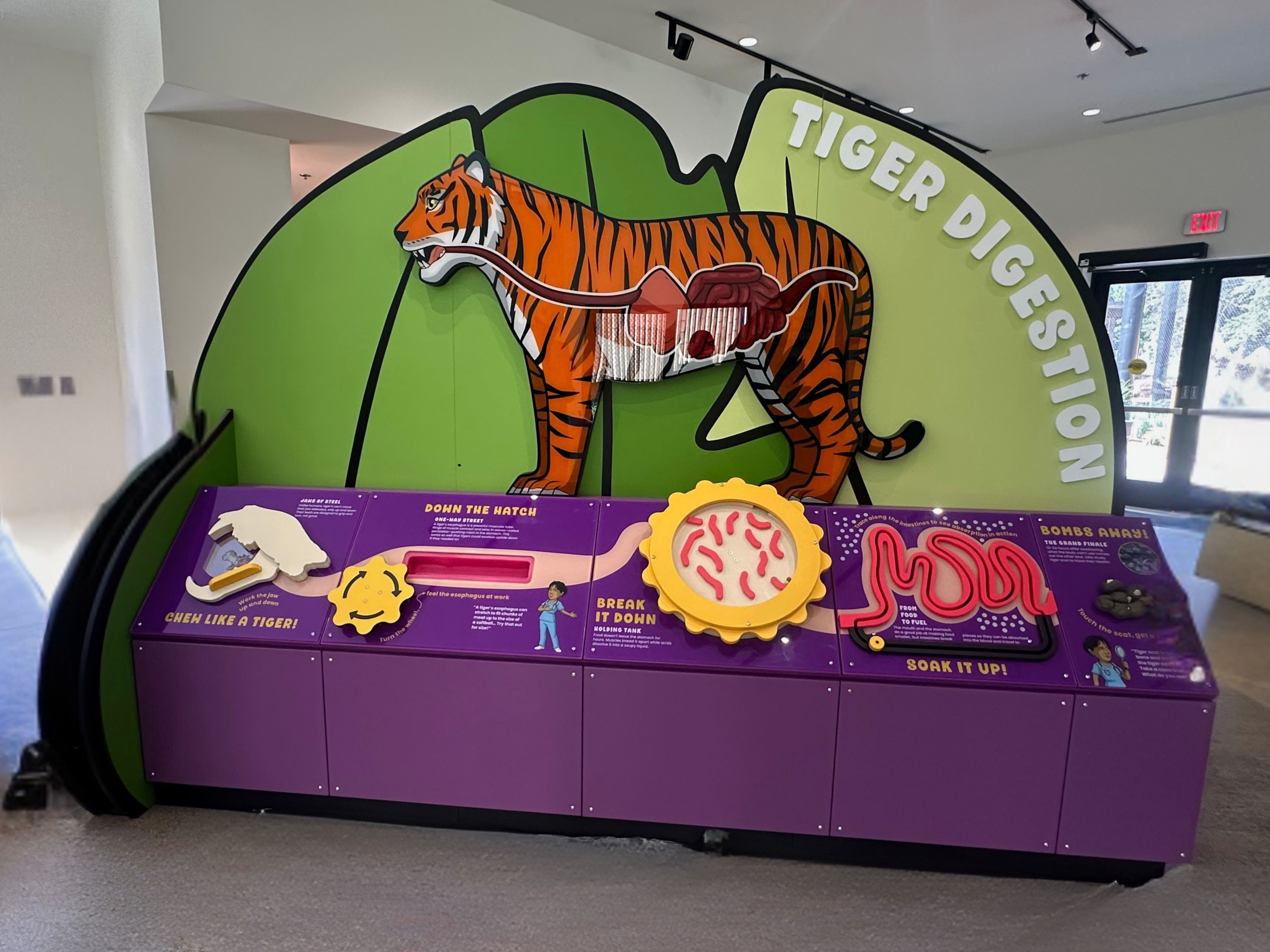
Working Studio was challenged to create an engaging, hands-on exploration of how a Sumatran tiger processes its food for visitors to Topeka Zoo’s new Mark and Bette Morris Family Tiger Trails and Den Academy. In partnership with the talented team at Studio Tectonic, we developed a five-part interactive experience that invites guests to “feed” a tiger and follow its meal through the digestive system—from the first bite to the final result. The experience is designed to make the science of carnivore digestion tangible, visual, and fun, while allowing multiple visitors to engage with the system at once.
The journey begins with Maceration, where visitors use a large mechanical tiger jaw to squeeze and “chew” a meal. As the jaw moves, an animated display shows the food being mechanically broken down into smaller pieces, demonstrating the first step of digestion and preparing the food for its journey through the body.
Next, visitors experience Peristalsis, the muscular movement that carries food from the mouth to the stomach. Turning a hand wheel engages a series of soft, textured “muscles” that contract around the food, helping guests visualize how the esophagus moves a meal through the digestive system. The interactive connects the physical sensation of turning the wheel with the otherwise invisible muscular action involved in swallowing and digestion.
At the Stomach, the process shifts from mechanical to chemical digestion. Guests rotate the stomach to see food and colorful nutrients move and break down, illustrating how stomach acids and digestive juices transform a meal into components that can be used—or discarded—by the body.
The journey continues through the Intestines, where visitors move food particles along the digestive tract and activate glowing LEDs. As the particles travel through the intestines, light radiates into the body to represent nutrients being absorbed through the intestinal walls, entering the bloodstream, and traveling to other systems throughout the tiger’s body.
Finally, what goes in must come out. At the Waste station, visitors can touch a realistic bronze model of tiger “waste” and trigger an unexpected—and decidedly silly—sound effect. The surprise ending adds a playful moment to the experience while reinforcing the complete journey of food through the digestive system.
Together, the five interactives transform the complex science of maceration, peristalsis, chemical digestion, absorption, and waste into a memorable, multisensory experience that encourages visitors to learn by doing—and discover what happens to a meal after a Sumatran tiger takes its first bite.
More Info
- Visit the Topkea Zoo
